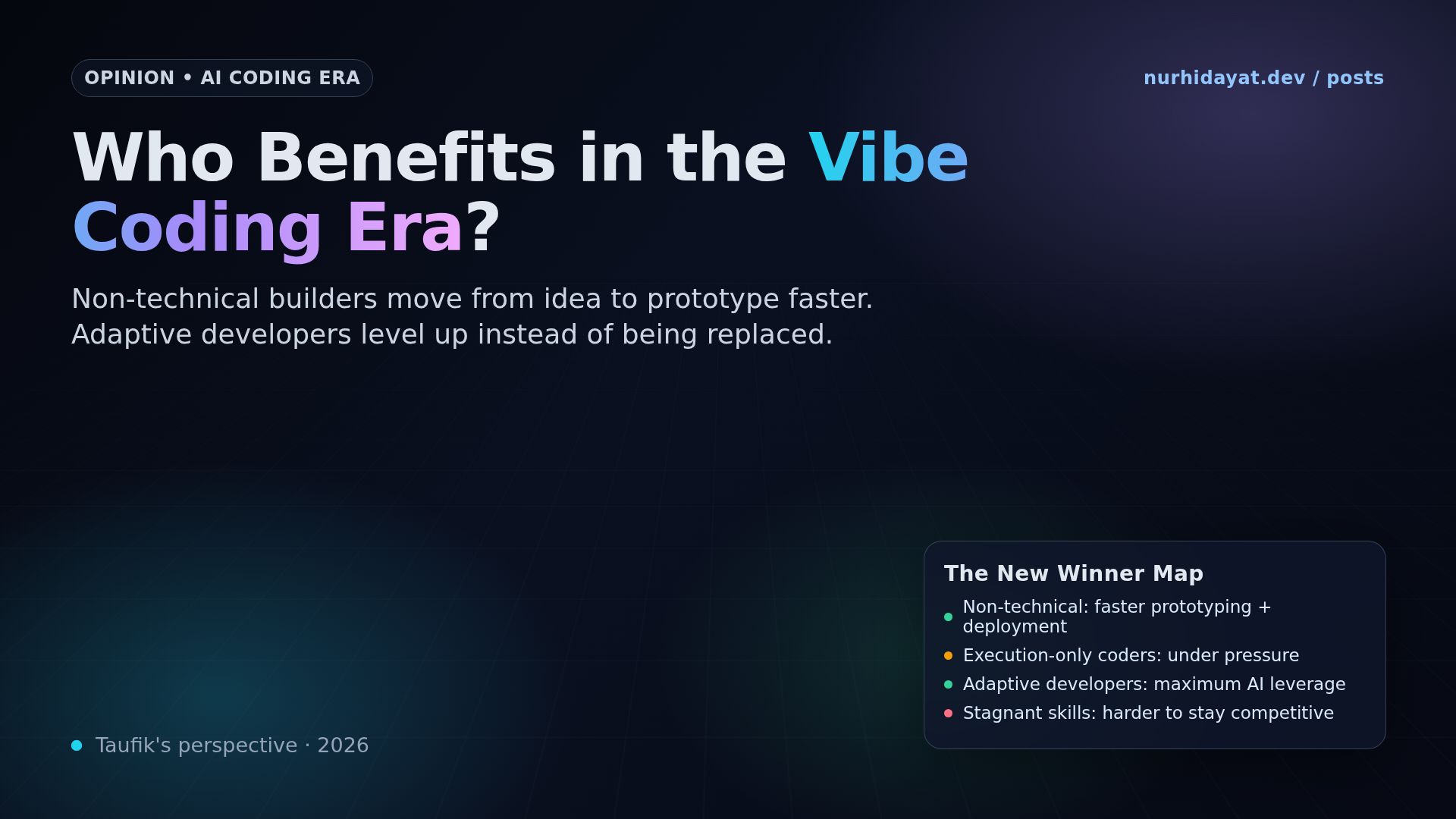
Who Benefits in the Vibe Coding Era?

In recent years, vibe coding has evolved from a niche experiment into a new way of working. With AI assistance, building software no longer depends entirely on writing code from scratch. As a result, the competitive landscape is changing.
That raises a critical question: who benefits the most, and who is at risk of being left behind?
1) The biggest winners: execution-driven non-technical people
Non-technical people now have significantly more leverage. If they previously stopped at the idea stage, many can now move into early execution.
With AI coding tools, they can:
- build prototypes much faster,
- validate ideas without waiting for a large team,
- and even handle simple deployments on their own.
The impact is clear: time-to-market gets shorter, and the barrier to building digital products drops sharply. In business terms, this means more experiments can happen at lower cost.
2) The most pressured group: programmers who only execute tasks
On the other hand, programmers whose role is limited to “receive instructions and write code” are becoming more vulnerable. Repetitive, highly structured tasks with little architectural judgment are increasingly easy for AI to handle.
This does not mean the programming profession is over. But it does mean the core value proposition is shifting: writing code alone is no longer enough to stand out.
If someone’s contribution stays at mechanical implementation, competition shifts to speed and efficiency—two areas where AI keeps improving fast.
3) The strongest position: adaptive programmers
Programmers who adapt are actually in the best position. AI accelerates their output instead of replacing their strategic value.
They are still essential for work AI cannot fully own, such as:
- system architecture decisions,
- technical and business trade-off analysis,
- quality assurance and reliability,
- security, scalability, and maintainability.
In other words, adaptive programmers move from “code producers” to problem solvers and system designers.
4) The real skill shift: from syntax to decision-making
The vibe coding era is shifting core competence:
- from writing syntax → to designing solutions,
- from task execution → to system orchestration,
- from “can code” → to “can create business impact.”
Those who can read context, set priorities, and direct AI effectively will outperform those focused only on raw code output.
Closing
In my view, vibe coding does not eliminate programmers—it redefines professional value.
- Fast-learning non-technical builders gain major advantages.
- Programmers who rely only on execution face disruption risk.
- Adaptive programmers gain the greatest acceleration.
Ultimately, winners in this era are not the fastest typists. They are the ones who can combine technical understanding, business context, and AI leverage to solve real problems.